The Vintage RV Goldmine How To Source Parts That No Longer Exist
Vintage RV projects stall when the exact latch, window, lens, or appliance trim is discontinued. This article shows how to use salvage yards as a practical sourcing system: how people typically find yards, what’s commonly available once you arrive, and a step-by-step method to identify part numbers, measure openings, and confirm compatibility before you spend time or money. You’ll also see the most common fitment traps (especially electrical and window hardware), plus a quick comparison of salvage versus new-old-stock and fabrication so you can choose the right path for parts that seem impossible to replace.
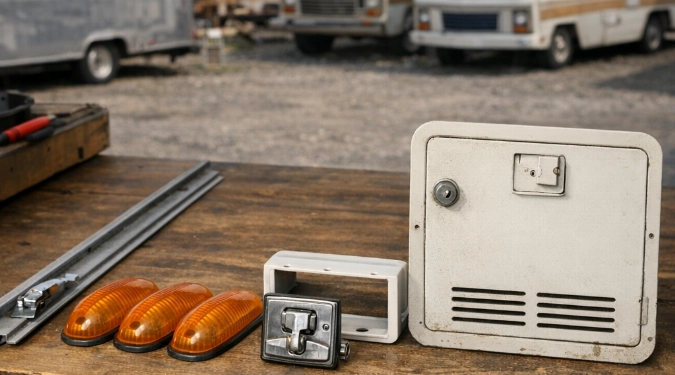
When a vintage rig needs a window crank from 1978 or a clearance light that stopped being made decades ago, the usual parts catalogs can’t help. The good news is that “obsolete” often just means “waiting in the right salvage pile.” This is how vintage owners turn salvage yards into a parts goldmine, without wasting time or buying the wrong piece.
Why Salvage Yards Solve The “No Longer Exists” Problem
Older RVs and motorhomes were built with manufacturer-specific trim, appliances, and hardware that rarely cross-reference cleanly to modern replacements. An RV parts salvage yard works because it preserves the original ecosystem: matching vents, baggage doors, latches, and even period-correct light fixtures pulled from rigs that are being dismantled.
Salvage yards also help when the part exists new, but the version you need doesn’t. Think Dometic and Norcold refrigerator doors and trim pieces, Atwood and Suburban furnace housings, or Hehr-style windows where a hinge or slider track changed slightly year to year. Those small revisions are exactly what makes used inventory valuable.
How People Typically Locate Salvage Yards
Most owners start with search terms like RV salvage yard near me or camper salvage yard near me, then widen the radius when the rig is rare. The smartest approach is to combine local searching with nationwide calls, because many yards ship smaller items (latches, lenses, control boards) and will measure parts for you.
Another common path is calling RV repair shops and body shops that regularly handle insurance totals. They often know which yards have steady turnover, which ones allow walk-through browsing, and which ones specialize in motorhomes versus travel trailers. If you’re specifically restoring a Class A or Class C, searching motorhome salvage yard near me can surface yards that see more coach-specific components.
What You Can Commonly Find In An RV Salvage Yard
Inventory varies by region and season, but yards commonly have exterior compartments, entry doors, windows, mirrors, steps, awning arms, roof vents, and generator parts. Interiors can yield cabinet doors, table hardware, drawer slides, older style faucets, and OEM trim pieces that are hard to match at a home center.
Appliance-related finds are often “assemblies” rather than individual components: a whole furnace of the same series, an A/C shroud that matches your unit, or a water heater door and bezel. For electrical, you may find older converter/chargers, fuse panels, and marker lights, though compatibility checks matter more here.
A Step-By-Step Method To Source Obsolete Parts Reliably
Step 1: Identify The Part Beyond The RV Model Name
Write down the RV’s year, make, and model, but also hunt the part’s own data plate. Appliances often have a model and serial tag (Dometic, Norcold, Atwood, Suburban). Windows may have an etched corner mark (for example, Hehr). This is the difference between “close enough” and “bolts right in.”
Step 2: Measure Like A Salvage Pro
For doors and windows, record rough opening size, flange size, corner radius, and thickness. For lights, note lens screw spacing and whether the base is surface-mount or recessed. Bring photos with a tape measure in frame; yards can confirm fit remotely, especially when you’re searching for used RV parts near me but inventory is scattered.
Step 3: Ask The Right Questions Before You Drive
- Is the RV already on-site and accessible, or still waiting to be processed?
- Do they allow customer removal, or is it staff-pulled only?
- Can they send close-up photos of mounting points, not just the face?
- Is there a return policy for electrical items like control boards?
Step 4: Expand The Search To “Donor Rig” Matches
Many vintage components were shared across multiple builders. If your exact model is rare, ask the yard what else uses the same window series, baggage door style, or appliance revision. This is where an RV junkyard near me may still help even if they don’t have your brand, because you’re really hunting the component family, not the logo on the side.
Compatibility Traps To Watch For With Vintage RV Parts
Electrical parts are the most mistake-prone. A converter from a similar-era coach may not match your battery chemistry or wiring layout. Lighting lenses can look identical but have different screw patterns. Window frames may fit the opening but differ in clamp ring depth. For safety-critical items (steps, hitch components, propane regulators), replacement with current-spec parts is often more appropriate than salvage, even if the old piece “fits.”
Also watch for water intrusion damage. A cabinet door might be perfect, but if the donor rig had roof leaks, hinges and fasteners may be corroded. Ask whether the donor area was dry and request underside photos when possible.
Quick Comparison: Salvage vs New-Old-Stock vs Fabrication
| Option | What It’s Best For | Main Tradeoff |
|---|---|---|
| Salvage Yard | OEM-fit doors, windows, trim, discontinued housings | Condition varies, may need cleaning or refurbishing |
| New-Old-Stock | Uninstalled vintage parts like lenses, knobs, decals | Hard to locate, storage age can make plastics brittle |
| Fabrication/Retrofit | Custom panels, updated appliances, modern seals | May lose original look, requires careful measuring |
FAQ: Vintage RV Salvage Yard Sourcing
Do Salvage Yards Ship Parts, Or Is It Pickup Only?
Many yards ship smaller items and will palletize larger pieces like doors if arranged in advance. Expect to provide measurements and confirm mounting details to avoid costly misfits.
Can I Walk The Yard And Pull Parts Myself?
Policies vary. Some allow self-service with basic rules (bring tools, sign a waiver), while others are staff-pull only for safety and inventory control. Ask before showing up so you know what tools and time to plan for.
How Do I Increase My Odds Of Finding Truly Obsolete Pieces?
Search by component brand and series, not only RV brand. Keeping a “donor list” of similar-era rigs, saving part numbers, and bringing a photo-and-measurement sheet helps yards confirm matches quickly.
Are Used Electrical Parts Worth It?
They can be, especially for discontinued trim pieces, housings, and non-critical assemblies. For control boards, converters, and safety-related components, confirm testing/return terms and consider modern replacements when compatibility or reliability is uncertain.
Conclusion
The vintage RV goldmine is real: salvage yards preserve the exact doors, windows, trim, and appliance variants that “no longer exist” in normal supply chains. With part numbers, precise measurements, the right questions, and a willingness to search beyond your exact RV model, you can source components that restore function and keep the rig’s original character intact.
Disclaimer: The information provided in this article is for educational and informational purposes only. It does not constitute professional advice. Readers should conduct their own research and consult with qualified professionals before making any decisions.